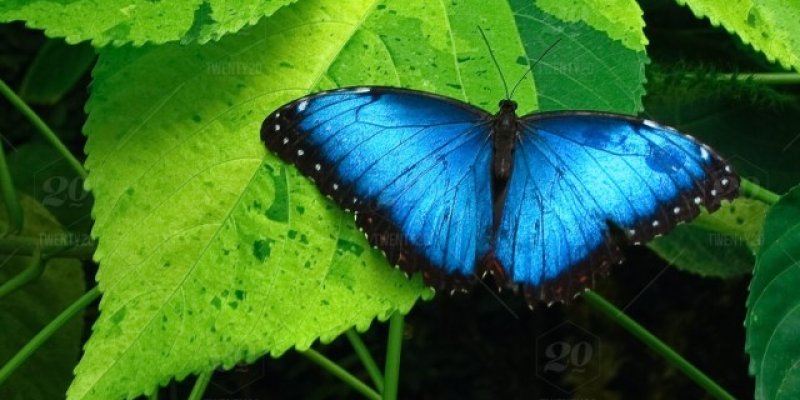
The world is an amazingly beautiful and colourful place, we can find all shades of the rainbow in plants and animals, but if you think about it, one particular colour is exceedingly rare to find (besides the ocean and the sky), and that colour is blue. There is a butterfly around my house that flashes the most brilliant blue when sunlight hits its wings. This made me wonder about why the colour blue is only present on a very small number of species, especially considering the untold diversity among life on this planet. And for the few species that have the colour blue, there’s something different about how the colour presents itself to us.
Usually for most anything, colorations exist because of organic molecules called pigments. How they work is that a pigment absorbs every colour in the light spectrum, except for the colour that they reflect, making them appear to be solely of that colour. So for instance, red pigments absorb every colour except red, green pigments absorb every colour but green, while black pigments absorb everything.
A lot of animals in nature can get their colours from eating food with pigmentations of that colour, one of the most well known examples is a Flamingo, they turn bright pink because of the shrimp they eat. But blue things in nature are a little different, let’s take this butterfly for instance. If you examine it closely and from different angles, the brilliant blue actually seems to shine and shimmer like a hologram, that’s because the blue colour emanating from this butterfly isn’t actually coming from pigments, as is with other normal colours in nature.
The blue colour it produces actually comes from the shape and structure of the microscopic scales in the wing. When light comes in, these microscopic structures refract wavelengths of colours all over the place, most colours are out of phase and get cancelled out, but if you’re lucky, the blue light that has just the right wavelength to be in sync, can be reflected back to us. That’s why it shimmers and changes from different angles, because the structure is reflecting different shades of blue that are currently in sync with where you’re standing. It’s created using principles of physics and engineering, which is amazing.
Outside of the ocean, almost every living thing that has the rare colour blue, has it because of special microscopic structures on the surface that very specifically bounces blue wavelength light to our eyes while canceling out the others. No mammal, avian or reptile that we know of actually have natural blue pigmentation on their bodies. So the next time you see a blue butterfly, you can better appreciate the brilliant iridescent colour it gives off, and how rare a beauty it is to find.