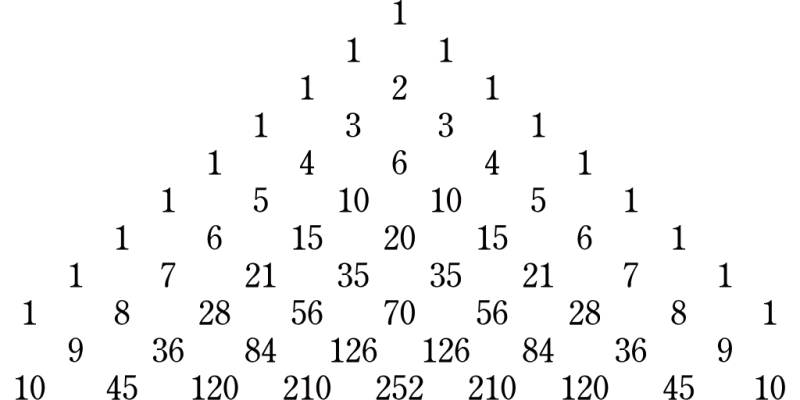
There’s this famous pattern of numbers in Math called Pascal’s triangle, named after the French philosopher and mathematician Blaise Pascal. Even though before it was attributed to him, the triangle was already in use hundreds of years before him in China and India.
This pattern of numbers generates an infinitely expanding, perfectly symmetrical triangle. Where each number is the sum of the numbers directly above it added together. That alone is very impressive, but there’s actually a lot more mathematical patterns hidden in the triangle; you can discover diagonals, horizontal sums, exponents, squares, odds and even numbers, fractals, even the fibonacci sequence.
I don’t pretend to understand all of it, but it is very interesting to know that all of these patterns exist within this triangular pattern. It’s not only there to look pretty, but there’s also plenty of practical applications to Pascal’s Triangle, particularly in the world of calculating probability. It’s simply a mathematical work of art and wondrous to behold, even to an untrained eye such as myself.