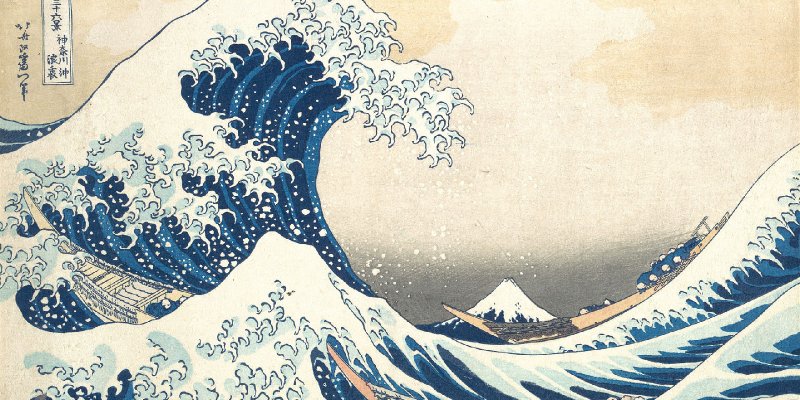
This is a famous piece of art that you surely have seen at least once. It’s certainly the most recognizable work of Japanese art in the world. It’s a wooden print depicting the beauty of Japan. But if you look closely, you’ll see three boats filled with terrified fishermen just about to be swallowed by the huge wave. The great wave seemingly eclipses Mount Fuji, the highest peak in the land, a spiritual icon for all the people of Japan.
Most people mistake the wave for a tsunami, and for good reason too, it looks huge. But it’s actually called a rogue wave, or “plunging breaker” scientifically. These sorts of waves are scary and deadly, they can come out of nowhere even in open seas, sinking anything unfortunate enough to stand in the way.
I’ll try to give this art piece some historical background. In 17th century Japan, the Tokugawa Shogunate decided that isolationism was the way forward and declared Sakoku (Closed Country). They closed their borders and forbade any outside culture’s influence on Japan, deeming them a threat to the stability of Japan. Nobody is permitted to enter or leave, to do so was punishable by death. This policy was in effect for over 200 years. During this time, there was an unprecedented growth in Japanese art and literature, an artistic period where every social class can enjoy art.
This particular work of art is named “The Great Wave off Kanagawa” made by Hokusai in 1830, as part of a larger series called “36 Views of Mount Fuji”. It’s not one singular painting but instead printed many times by hand on wooden blocks, this art form is called “ukiyo-e”. You can find the original prints all around the world, since there’s an estimated five to eight thousand woodblock prints of “The Great Wave” produced at the time. The earlier the print, the higher it’s valued.
Back then, traditional forms of art such as paintings were reserved for the higher classes, but new art forms such as the mass-producible prints of Ukiyo-e meant that art was no longer restricted to those of higher status. People collected woodprints like trading cards, since buying a print is as cheap as buying a bowl of ramen. And “The Great Wave” was one of the most famous within the country, and it sparked international interest in Japanese art when it finally was circulated out of Japan.
Even the colours used in “The Great Wave” are unique. It is the first ever that used Prussian Blue, a formerly expensive and hard to get synthetic color. But opening trade with China meant that acquiring it for printing was possible. The colors usually used in traditional woodblock prints were often muted and pale, while “The Great Wave” uses a striking blue, further setting it apart from other prints.
The artist Hokusai believed that art has a life force of its own. And you can definitely feel it when you look at “The Great Wave”. This image depicts Japan facing an uncertain future, unsure of their place in a fastly modernizing world. But even though the seas are rough and dangerous, the soul of the Japanese people, represented by Mount Fuji in the background, stands solid and unwavering. Ready to face the oncoming wave of the future, and come out the other side stronger.