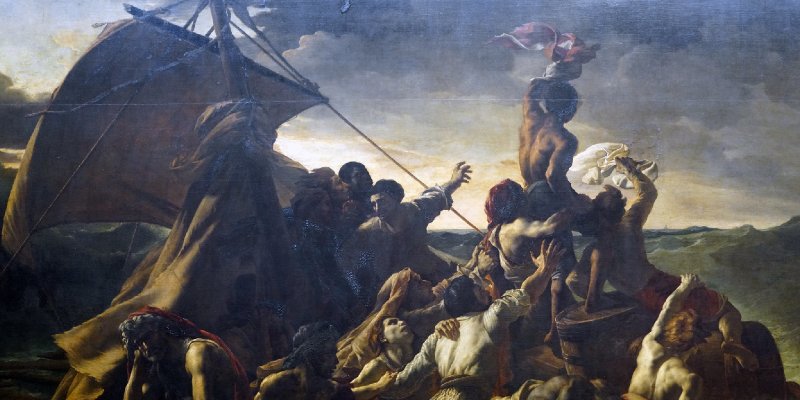
The Raft of the Medusa is a historic painting with a tragic true story behind it, carrying an inspirational revolutionary message that went against the expected norm of the time. It was painted by Théodore Géricault with a massive 5x7 meters in size, and it took him close to 2 years to complete. It’s a dark painting, both in its subject matter and lighting choices, the stark contrast of Chiaroscuro is readily apparent. First, let’s visit the actual history that inspired this art piece.
The Medusa was a French Frigate bound to Senegal, West Africa, due to the incompetence of her captain, the ship hit the ground and sank, setting off a horrific chain of events that sent waves across the world. It was a horrific tragedy that was a perfect example of the corruption, social stratification and chaos that enveloped France at the time. In 1815, the French Monarchy was in power. It was the King who gave an unqualified supporter the captaincy of the Medusa as a political favor. The captain hadn’t been to sea for more than 20 years, it was his inexperience that led to the ship running aground off the coast of Africa on that fateful journey.
There were only a handful of lifeboats available, and they were all reserved for the Captain, senior officers and the higher class. The rest of the crew and passengers (which numbered over a hundred people) were forced to create a makeshift raft out of the remains of their doomed ship in order to survive. The lifeboats towed the raft for a while, but the Captain made the cowardly decision to cut the rope and abandon the people on the raft to their fate.
The next 13 days on that raft would be hell. In the first night alone 20 people were murdered, and the violence driven by desperation would only increase with the days. By the fourth day there were only 67 people left out of the original 147. To survive they had been forced to murder and cannibalize their fellow humans, it was truly an unimaginable, hellish scenario for everyone involved. When the raft was finally found by a passing ship after 13 days drifting across the sea, there were only 15 people left alive.
This painting depicts a]the moment where the survivors spot a ship in the distance, as they frantically try to signal for help and get its attention. Unfortunately this was not the point where they were rescued, as the faraway ship (which is little more than a dot in the painting) didn’t see the raft and disappeared over the horizon.
The emotion and expression is different in every section of the painting. From the trauma and despair emanating from the people on the lower left, to the hopeful and triumphant pose of the people on the upper right hand side. Let’s discuss the interesting and unusual parts of the painting, and why it was important and so unusual at the time.
The choice to portray a black man as the most central, heroic part of the painting in the age of slavery was controversial to say the least; it led to the beginning of the Abolitionist movement. And instead of portraying the rich nobility as the subjects of the painting, Géricault chose to depict the common man and their struggles in a disaster caused by the upper class, it was certainly a groundbreaking and revolutionary social commentary.
Géricault never sold The Raft of the Medusa when he was alive, he died young, and most tragically, he probably believed himself to be a failure. It was only years after his death that the Louvre saw this painting as the masterpiece it is, and bought it. It is still displayed there, and it’s popularity and influence is only second to the Mona Lisa.